4.2 2025 Remuneration report
The Supervisory Board hereby presents the remuneration report for the members of the Board of Directors and the Supervisory Board for the 2025 financial year.
The remuneration report has been prepared in accordance with the provisions of Article 2:135(b) of the Dutch Civil Code and the Corporate Governance Code 2025. The remuneration report provides information about the remuneration policy pursued during the 2025 financial year to ensure transparency for all stakeholders. On 17 April 2025, the annual general meeting adopted the current remuneration policy for the Board of Directors (new window).
The remuneration policy supports Nedap’s strategy and sustainable long-term value creation by aligning total remuneration with long-term performance, strategic priorities and shareholder interests through a balanced mix of fixed remuneration, short-term incentives and long-term incentives.
Implementation of the remuneration policy in 2025
Following adoption by the general meeting, the revised remuneration policies for both the Board of Directors and the Supervisory Board entered into force with effect from 1 January 2025. The policies were implemented as approved, without deviations.
The remuneration framework applied in 2025 reflects Nedap’s strategic objectives, governance principles and focus on sustainable long-term value creation. In applying the remuneration policies, the Supervisory Board took into account internal pay ratios, market developments, Nedap’s performance and broader societal considerations.
At the annual general meeting of 17 April 2025, the 2024 remuneration report was approved by a majority of the votes cast (99.99%). The Supervisory Board took note of the outcome of the advisory vote and the discussions held at the meeting. As no material objections or points of attention were raised, no amendments to the 2025 remuneration report were deemed necessary (other than those resulting from the implementation of the revised remuneration policies).
Remuneration summary
The table below provides a summary of the costs for the current members of the Board of Directors as recognized in the financial statements.
|
(€ x 1,000) |
Basic income |
Variable remuneration |
Employee participation plan benefits |
Long-Term Incentive (LTI) |
Pension costs |
Total |
|||||
|---|---|---|---|---|---|---|---|---|---|---|---|
|
2025 1 |
|||||||||||
|
Mr. R. M. Wegman |
505 |
248 |
31 |
71 |
109 |
964 |
|||||
|
Mr. R. Schuurman |
363 |
175 |
17 |
50 |
69 |
674 |
|||||
|
Ms. H. P. J. M. Jans |
179 |
86 |
- |
25 |
30 |
320 |
|||||
|
Ms. D. van der Sluijs |
559 |
- |
49 |
- |
34 |
642 |
|||||
|
Total |
1,606 |
509 |
97 |
146 |
242 |
2,600 |
|||||
|
2024 |
|||||||||||
|
Mr. R. M. Wegman |
486 |
267 |
49 |
- |
108 |
910 |
|||||
|
Mr. R. Schuurman |
306 |
166 |
25 |
- |
61 |
558 |
|||||
|
Ms. D. van der Sluijs |
347 |
189 |
31 |
- |
58 |
625 |
|||||
|
Total |
1,139 |
622 |
105 |
- |
227 |
2,093 |
- 1Ms. H. P. J. M. Jans’s contract commenced on 1 July 2025, and Ms. D. van der Sluijs’s contract ended on 31 July 2025. The basic income of Ms. D. van der Sluijs includes a contractual severance payment of €350, relating to her departure following the annual general meeting in 2025 upon termination of her board position.
The table below provides a summary of the remuneration awarded to the members of the Board of Directors in the financial year.
|
(€ x 1,000) |
Fixed remuneration |
Variable remuneration |
Total remuneration |
Variable remuneration as % of total remuneration |
||||||
|---|---|---|---|---|---|---|---|---|---|---|
|
1. Basic salary1 |
2. Pension and other allowances |
3. Variable remuneration |
4. Share-based remuneration |
|||||||
|
3a. Paid out |
3b. Used to purchase depositary receipts2 |
4a. Purchase discount for depositary receipts3 |
4b. 4:1 Matching depositary receipts4 |
|||||||
|
Mr. R. M. Wegman, CEO |
2025 |
492 |
109 |
248 |
- |
15 |
48 |
912 |
34% |
|
|
2024 |
473 |
108 |
- |
267 |
17 |
48 |
913 |
36% |
||
|
Mr. R. Schuurman, CCO |
2025 |
350 |
69 |
175 |
- |
9 |
9 |
612 |
32% |
|
|
2024 |
294 |
61 |
- |
166 |
10 |
11 |
542 |
35% |
||
|
Ms. H. P. J. M. Jans, CFO |
2025 |
173 |
30 |
86 |
- |
- |
- |
289 |
30% |
|
|
2024 |
- |
- |
- |
- |
- |
- |
- |
- |
||
|
Ms. D. van der Sluijs |
2025 |
552 |
35 |
- |
- |
8 |
18 |
613 |
4% |
|
|
2024 |
334 |
58 |
47 |
142 |
12 |
- |
593 |
34% |
||
- 1The basic salary does not include the employer’s social security contributions.
- 2‘Depositary receipts’ means ‘certificates’.
- 3This is the amount of the discount given on the purchase of depositary receipts in the financial year.
- 4This is the value of the depositary receipts awarded.
Fixed annual income
The fixed annual income is in line with the current remuneration policy and is incremented at the same rate as the rate used for employees, as agreed in Nedap’s collective labor agreement.
Variable annual income
Variable remuneration for the Board of Directors in 2025 consisted of a Short-Term Incentive (STI) and a Long-Term Incentive (LTI), reflecting the revised remuneration structure.
Short-Term Incentive (STI)
The STI is designed to incentivize the achievement of Nedap’s annual strategic, operational and financial priorities. For 2025, the STI was composed of:
50% financial performance criteria; and
50% non-financial performance criteria.
The financial and non-financial performance criteria were determined ex ante by the Supervisory Board and aligned with Nedap’s strategy and key priorities. The specific criteria applied for 2025 were disclosed prior to the start of the performance year.
The STI payout is determined using an additive model, based on the extent to which predefined threshold, target and maximum performance levels were achieved. Performance below threshold does not result in a payout.
After the end of the financial year, the Supervisory Board assessed the actual performance against the predetermined criteria and determined the STI outcome in accordance with the remuneration policy. In doing so, the Supervisory Board applied a reasonableness and fairness test and concluded that the resulting outcome appropriately reflected both performance achieved and the manner in which that performance was realized.
|
(In € x 1M or as a percentage) |
Target |
Performance |
Share of variable remuneration |
|
Financial performance |
|||
|
EBIT |
11.1% |
11.3% |
9% |
|
Recurring revenue |
114.7 |
111.5 |
6% |
|
Working capital ratio |
14% |
9% |
12% |
|
Total financial performance |
27% |
||
|
Non-financial performance |
|||
|
Customer focus |
3.0 |
2.7 |
11% |
|
Strategic business transformation |
3.0 |
2.9 |
12% |
|
Total non-financial performance |
23% |
||
|
Total performance |
50% |
Financial performance criteria
The financial targets have been split up into three sub-targets. The table above shows each sub-target, along with the extent to which it was achieved in the 2025 financial year and how much of the variable remuneration it represents.
Based on the above table, the Board of Directors is awarded a financial targets-related variable component of their annual income that represents 27% of their fixed annual income.
Non-financial performance criteria
The non-financial component of the STI for 2025 was based on two criteria: (i) Strategic business transformation and (ii) Customer focus. Both criteria were weighted equally.
The Supervisory Board defined four performance levels for each criterion (below threshold, threshold, target and maximum), linked to predefined qualitative criteria and corresponding payout percentages of 0%, 50%, 100% and 150%, respectively. Between threshold, target and maximum, payout is determined on a linear basis.
Strategic business transformation
In 2025, Nedap implemented a structured company-wide approach, in line with its Create & Scale growth strategy, to strengthen the execution of strategic priorities. Strategic investment propositions were assessed against defined commercial, operational and development criteria, aimed at achieving sustainable performance within predefined timeframes. Accountability for execution and follow-up was explicitly assigned, and progress was monitored periodically using a limited set of indicators to support prioritization and capital allocation decisions.
The approach has been embedded within the Healthcare and Retail markets. In the Security and Livestock markets, initial execution cycles were completed in 2025.
The Supervisory Board notes an improvement in execution cadence and follow-up of strategic initiatives during 2025. In view of the predefined criteria for this target, including the degree of implementation, consistency of use across markets and teams, and observable impact on execution, the Supervisory Board determined that performance was between threshold and target level, close to target.
Based on this assessment, the Supervisory Board awarded 12% variable pay for this component.
Customer focus
In 2025, Nedap further developed its structured end-to-end customer process across sales, marketing, account management and customer excellence. For relevant SaaS teams, the BowTie methodology was implemented and embedded in commercial systems, contributing to greater consistency in pipeline management and improved insight into conversion data. For certain propositions, further integration remains in progress.
In assessing performance against the predefined criteria, including the level of roll-out, system integration and the use of conversion data for steering, the Supervisory Board concluded that performance was between threshold and target level, close to target.
Based on this assessment, the Supervisory Board awarded 11% variable pay for this component.
Long-Term Incentive (LTI) plan
The Long-Term Incentive (LTI) plan for the Board of Directors is designed to promote sustainable long-term value creation and to align the interests of directors with those of shareholders. The LTI takes the form of a Performance Share Unit (PSU) plan, under which conditional performance shares are granted annually. The on-target value of the LTI award amounts to 50% of fixed annual income, with a maximum opportunity of 75%, depending on performance. Vesting is subject to the achievement of predefined performance criteria measured over a three-year performance period (2025–2027). These criteria comprise sales growth within key markets (40%), earnings per share growth (35%) and ESG objectives (25%), reflecting Nedap’s strategic, financial and sustainability priorities. For each criterion, vesting ranges from 0% below threshold to a maximum of 150% at outstanding performance. Shares that vest after the three-year performance period are subject to a subsequent two-year holding period, during which members of the Board of Directors are required to retain the shares, except for those sold to meet tax and social security obligations. This structure reinforces a long-term focus and supports sustained value creation for the company.
The number of conditionally granted performance shares under the LTI plan is determined by reference to the average Nedap share price over the five trading days immediately preceding the grant date. The fair value of the granted PSUs is determined at grant date in accordance with applicable accounting standards. In calculating the fair value, an adjustment is applied to reflect the absence of dividend entitlement during the vesting and holding periods. This adjustment is based on a discount equal to the average dividend yield of Nedap shares over the past five years.
Given the commercially sensitive nature of certain targets, detailed quantitative target ranges will be disclosed ex post, following completion of the performance period.
|
2025 |
Basic salary as of 31/12 (€ x 1,000) |
Award value |
Share price |
Granted PSUs |
Fair value |
Costs (€ x 1,000) |
|||||
|---|---|---|---|---|---|---|---|---|---|---|---|
|
Total |
146 |
||||||||||
|
Mr. R. M. Wegman |
496 |
50% |
62.40 |
3,977 |
53.77 |
71 |
|||||
|
Mr. R. Schuurman |
350 |
50% |
62.40 |
2,805 |
53.77 |
50 |
|||||
|
Ms. H. P. J. M. Jans |
345 |
50% |
62.40 |
1,382 |
53.77 |
25 |
|||||
In 2025, no PSUs vested or were forfeited.
Share ownership and alignment with shareholders
In accordance with the remuneration policy, share ownership guidelines apply to the members of the Board of Directors with the objective of strengthening alignment with the long-term interests of shareholders.
Under these guidelines, the CEO is required to hold shares representing 150% of gross fixed annual income, while the other members of the Board of Directors are required to hold shares representing 100% of gross fixed annual income.
Share ownership is built up gradually, primarily through the vesting of performance shares awarded under the Long-Term Incentive (LTI) plan. Directors are permitted to sell shares at vesting to cover tax and social security obligations. Share positions accumulated under previous remuneration arrangements are taken into account when assessing compliance with the guidelines.
The Supervisory Board monitors compliance with the share ownership guidelines on an ongoing basis. As the LTI plan was introduced in 2025, the required shareholding levels have not yet been fully achieved by all members of the Board of Directors. No cases of non-compliance occurred in 2025.
Overview of share ownership
|
(As of 31 December) |
Gross fixed annual income (€ x 1,000) |
Depositary receipts or shares held (x 1)* |
Share price (€ x 1) |
Share ownership (€ x 1,000) |
Share value in percentage of gross income |
||||||
|
Mr. R. M. Wegman, CEO |
2025 |
492 |
55,069 |
89.90 |
4,951 |
1,006% |
|||||
|
2024 |
473 |
51,608 |
55.00 |
2,838 |
600% |
||||||
|
Mr. R. Schuurman, CCO |
2025 |
350 |
10,426 |
89.90 |
937 |
268% |
|||||
|
2024 |
294 |
8,592 |
55.00 |
473 |
161% |
||||||
|
Ms. H. P. J. M. Jans, CFO |
2025 |
345 |
- |
89.90 |
- |
- |
|||||
|
2024 |
- |
- |
55.00 |
- |
- |
* Ms. D. van der Sluijs’s shareholding position is not included, as she stepped down as a director under the articles of association. Mr. R. M. Wegman holds both shares and depositary receipts. Mr. R. Schuurman holds depositary receipts.
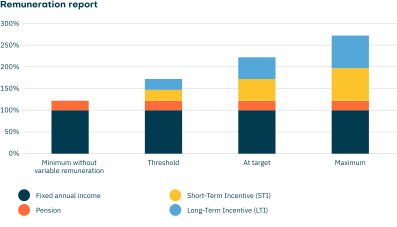
Directors’ pay mix
|
STI |
LTI |
Total Variable |
|
|---|---|---|---|
|
Performance Level |
(% of Fixed Annual Income) |
(% of Fixed Annual Income) |
Remuneration |
|
Minimum |
0% |
0% |
0% |
|
Threshold |
25% |
25% |
50% |
|
At target |
50% |
50% |
100% |
|
Maximum |
75% |
75% |
150% |
Board member remuneration scenarios (as % of basic salary)
|
(Items x 1) |
Depositary receipts or shares held as of 1/1* |
Depositary receipts purchased |
Bonus depositary receipts awarded |
Depositary receipts or shares sold |
Depositary receipts or shares held as of 31/12* |
Contingent bonus depositary receipts as of 1/1 |
Contingent bonus depositary receipts awarded |
Bonus depositary receipts awarded |
Contingent bonus depositary receipts as of 31/12** |
|||
|
Mr. R. M. Wegman, CEO |
2025 |
51,608 |
2,726 |
735 |
- |
55,069 |
2,817 |
682 |
-735 |
2,764 |
||
|
2024 |
48,277 |
2,628 |
703 |
- |
51,608 |
2,863 |
657 |
-703 |
2,817 |
|||
|
Mr. R. Schuurman, CCO |
2025 |
8,592 |
1,692 |
142 |
- |
10,426 |
1,182 |
423 |
-142 |
1,463 |
||
|
2024 |
6,806 |
1,631 |
155 |
- |
8,592 |
929 |
408 |
-155 |
1,182 |
|||
|
Ms. D. van der Sluijs |
2025 |
6,469 |
1,443 |
272 |
- |
8,184 |
1,618 |
- |
-272 |
- |
||
|
2024 |
4,614 |
1,855 |
- |
- |
6,469 |
1,154 |
464 |
- |
1,618 |
|
Change in remuneration (€ x 1,000) |
2025 |
2024 |
2023 |
2022 |
2021 |
2025-2021 |
||
|
Change in director’s remuneration vs last year |
||||||||
|
Mr. R. M. Wegman, CEO |
0% (912) |
-2% (913) |
5% (930) |
0% (883) |
11% (885) |
3% |
||
|
Mr. R. Schuurman, CCO |
13% (612) |
0% (542) |
8% (541) |
- (503) |
- |
- |
||
|
Ms. H. P. J. M. Jans, CFO |
- (578) |
- |
- |
- |
- |
- |
||
|
Ms. D. van der Sluijs |
3% (613) |
-1% (593) |
6% (601) |
0% (565) |
29% (564) |
9% |
||
|
Supervisory Board members |
||||||||
|
Mr. P. A. M. van Bommel |
32% (66) |
0% (50) |
0% (50) |
25% (50) |
- (40) |
65% |
||
|
Ms. K. T. V. Bergstein |
- (46) |
- |
- |
- |
- |
- |
||
|
Mr. J. M. L. van Engelen |
15% (46) |
0% (40) |
0% (40) |
0% (40) |
33% (40) |
-68% |
||
|
Mr. G. F. Kolff |
- |
- |
- |
0% (50) |
25% (50) |
- |
||
|
Ms. M. Pijnenborg |
23% (49) |
0% (40) |
0% (40) |
0% (40) |
33% (40) |
23% |
||
|
Mr. S. C. Santema |
15% (46) |
0% (40) |
- (40) |
- |
- |
- |
||
|
Ms. M. A. Scheltema |
23% (49) |
0% (40) |
0% (40) |
0% (40) |
33% (40) |
23% |
||
|
Change in Nedap’s performance |
69% |
-9% |
22% |
-7% |
27% |
105% |
||
|
Change in median employee remuneration |
10% (109) |
0% (99) |
9% (99) |
3% (91) |
49% (88) |
|||
|
CEO pay ratio |
8.9 |
9.2 |
9.2 |
9.6 |
9.9 |
If a director or Supervisory Board member was a member of the Board of Directors or Supervisory Board for only part of a year, their remuneration is presented on a pro rata basis for comparison purposes. The change in remuneration for the members of the Board of Directors and Supervisory Board is measured by dividing remuneration for the financial year by remuneration received in the previous financial year. If the date of appointment as director under the articles of association or Supervisory Board member is not 1 January, the change is recognized on a pro rata basis in the financial year following the year of joining.
The change in the pay ratio is primarily driven by the variable nature of the CEO’s remuneration. A larger portion of the CEO’s compensation depends on performance-based components, which can fluctuate from year to year. In contrast, employee remuneration is more stable and follows a more gradual change path, resulting in a different overall development of remuneration levels and, consequently, the pay ratio. In compliance with the Corporate Governance Code disclosure requirements, provision 3.4.1(iv), the pay ratio for 2020 is 9.7.
The 2025-2021 column shows the relative change as of 31 December 2025 compared to the beginning of 2021.
The change in Nedap’s performance in any financial year is the change in the closing price of Nedap shares in the financial year, plus the dividend paid for the financial year, divided by the closing price of Nedap shares in the previous financial year.
Use of reclaiming scheme
In accordance with the remuneration policy and Article 2:135(8) of the Dutch Civil Code, the Supervisory Board has the authority to reclaim variable remuneration awarded to members of the Board of Directors (claw back or hold back), where applicable. In 2025, no variable remuneration was reclaimed or adjusted, and the reclaiming scheme was not applied.
Deviations from the remuneration policy
There were no deviations from the remuneration policy.
Loans and guarantees
The company has not granted members of the Board of Directors any loans or guarantees.
Pay ratio
Nedap follows the recommendation of the Corporate Governance Monitoring Committee as reflected in the Dutch Corporate Governance Code 2025. In this context, the pay ratio is defined as the ratio between (i) the total annual remuneration of the CEO and (ii) the average annual remuneration of employees of the company and its group companies included in the consolidated financial statements, whereby:
The total annual CEO pay includes all pay components (fixed pay, variable pay in cash (bonus), share-based pay, social security contributions, pension, expense allowance, etc.), as recognized in the (consolidated) financial statements prepared based on IFRS accounting standards.
Employees’ average annual pay is calculated by dividing total wage and salary costs in the financial year (as recognized in the (consolidated) financial statements prepared based on IFRS accounting standards) by the average number of FTEs at the company during the financial year. The pay of insourced external workers is factored in on a pro rata basis, on the condition that they worked for the company for at least three months during the financial year. The value of the share-based part of the pay is calculated on the date that it is awarded, as per the applicable IFRS accounting standards requirements.
The pay ratio for 2025 is 8.9. In 2024, the pay ratio was 9.2.
Ex ante disclosure of STI and LTI performance criteria 2026
In line with the current remuneration policy, the Supervisory Board provides ex ante disclosure of the performance criteria that will apply to the variable remuneration of the Board of Directors for the 2026 financial year.
The performance criteria for both the Short-Term Incentive (STI) and the Long-Term Incentive (LTI) are aligned with Nedap’s strategy, long-term value creation objectives and sustainability ambitions. The Supervisory Board annually reviews and determines the applicable criteria, taking into account strategic priorities, internal and external developments and stakeholder interests.
Short-Term Incentive (STI) 2026
For 2026, the STI will continue to consist of a balanced set of financial and non-financial performance criteria, each representing 50% of the total STI opportunity.
The financial performance criteria for 2026 are based on three equally weighted criteria:
Recurring revenue
Reflects the stability and predictability of revenue streams from ongoing customer contracts and subscriptions.EBIT margin
Measures operational profitability by evaluating earnings before interest and taxes as a percentage of revenue. It reflects Nedap’s ability to generate profit from its core operations.Working capital ratio
Working capital is used as a key indicator due to its direct impact on operational efficiency and financial stability. Effective working capital management contributes to a healthy cash flow and enables Nedap to make investments that support sustainable growth. This approach aligns well with the current phase of the business model, where capital efficiency plays an important role.
The non-financial performance component for 2026 is based on two equally weighted criteria:
Customer process scalability and internationalization: Focused on the further development of a predictable, repeatable and internationally scalable customer process for XaaS propositions. This includes the clarification of roles and responsibilities, alignment across business units, and the structural embedding of processes and systems to support scalable growth.
Joint technology foundation (Cloud, AI and Data): Focused on establishing a shared technology foundation to support cloud-based, data-driven and AI-enabled development across the organization.
Long-Term Incentive (LTI) 2026–2028
The LTI grant for 2026 will be based on performance over a three-year period (2026–2028) and will consist of conditional performance share units.
The LTI performance criteria will continue to reflect Nedap’s focus on sustainable long-term value creation and include:
Sales growth (40%)
The growth target is based on the average annual revenue growth within key markets over the 2026-2028 period.Earnings per Share (EPS) (35%)
The objective is to achieve ambitious EPS growth in line with Nedap’s strategic and financial ambitions.ESG-related performance objectives (25%)
Nedap aims for an annual intensity-based reduction in scope 3 GHG emissions per million euros of added value, in line with the Science Based Targets initiative (SBTi). This means that the 2028 target is set for a sustainable intensity-based reduction of GHG emissions per million euros of added value.
Supervisory Board member remuneration
On 17 April 2025, the annual general meeting adopted the current remuneration policy for the Supervisory Board. The policy reflects the increased responsibilities, time commitment and committee structure of the Supervisory Board.
Supervisory Board members receive fixed remuneration only, supplemented by committee fees where applicable. Remuneration is not linked to company performance and does not include variable or share-based components.
The amounts paid are in line with the remuneration policy for Supervisory Board members. The table below lists the remuneration that (former) Supervisory Board members received for the 2025 and 2024 financial years.
|
Supervisory Board members (€ x 1,000) |
2025 |
2024 |
|
Mr. P. A. M. van Bommel |
66 |
50 |
|
Ms. K. T. V. Bergstein (from 17 April 2025) |
33 |
- |
|
Mr. J. M. L. van Engelen (until 17 April 2025) |
13 |
40 |
|
Ms. M. Pijnenborg |
49 |
40 |
|
Mr. S. C. Santema |
46 |
40 |
|
Ms. M. A. Scheltema |
49 |
40 |
The company has not granted Supervisory Board members any loans or guarantees.