2.4 Progress on our sustainable impact
We advanced our sustainability strategy in 2025 with a focus on reducing greenhouse gas (GHG) emissions from our own operations, reducing product GHG emissions in the production and use phases, and engaging with our customers and suppliers around their sustainability challenges. Our performance in 2025 shows we can make meaningful progress, even amid external challenges.
Our sustainability strategy has been successfully implemented and embedded across our organization. Our sustainability team continued to support the business units in executing their strategy with a focus on designing products for durability, energy efficiency, and circularity.
Additionally, we moved ahead in making our own operations more sustainable. The publication of our first sustainability statement, prepared in accordance with the requirements of the Corporate Sustainability Reporting Directive (CSRD), was a milestone for Nedap. Beyond compliance, this process equipped us to accelerate our sustainability efforts by establishing Nedap-wide and business unit strategies, implementing robust data-collection and analysis processes, and developing monitoring and reporting protocols. We have created a solid foundation for advancing our sustainability objectives, and we continue to standardize and automate our processes to improve our performance.
In this chapter, we present a high-level overview of our sustainable impact in 2025. For additional information, we refer to chapter 8 Sustainability statement.

Overview of our GHG emissions
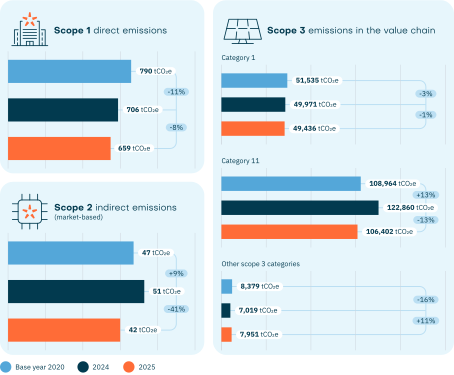
To provide insight into our climate impact and progress over time, the figure below presents an overview of GHG emissions across scope 1, 2, and 3. It shows our GHG emissions trend and the effect of the measures we have taken, reflecting our strategic focus on reducing GHG emissions across our operations, products, and value chain.
Sustainable by default
Target
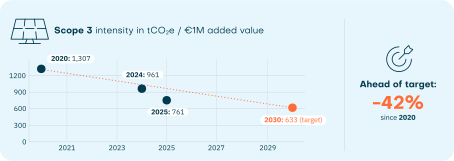
Reduce our scope 3 GHG emissions from purchased goods and services and the use of sold products by 51.6% per euro of added value by 2030 from a 2020 base year.
We can achieve meaningful reductions in our scope 3 GHG emissions by lowering our product use GHG emissions and by designing products with lower GHG emissions in the production phase. Measures to achieve this include strategic, portfolio-level decisions such as prioritizing SaaS business models, as well as product-level improvements like integrating energy-saving features and selecting more energy-efficient components for products with relatively high GHG emissions compared with the added value they provide for our customers. In 2025, our business units continued to implement and refine these GHG emissions reduction measures, supported by insights from life cycle analyses (LCAs).
We measure our progress toward this target by tracking reductions in our scope 3 intensity-based GHG emissions. Our SBTi-validated target requires a 7% annual reduction from our 2020 baseline. In 2025, we achieved this goal. This was driven by an increase in our added value and a significant decrease in use phase GHG emissions (category 11), as high-emissions products made up a smaller share of sales.
Ambition
Increase the circularity of our products through sustainable product design and collaboration across the value chain.
In the updated Double Materiality Assessment (DMA) in 2025, the subtopic resource outflows under ESRS E5 did not meet the materiality threshold. Business units tailor their approach to their markets, taking into account the nature of their products (including end-of-life considerations) and customer expectations. Current initiatives include conducting and learning from pilots with value chain partners, evaluating product recyclability in practice, and driving value chain transparency through product data. Details on our DMA update are provided in chapter 8 Sustainability statement.
Nedap has also implemented a company-wide packaging policy aimed at reducing packaging volumes and promoting the use of recyclable or reusable materials. In addition, the development of a GPT-based tool supports designers and engineers in making informed design choices during product development.
Nedap remains an active partner in the Circular Circuits research project, an initiative by TU Delft with funding from the Dutch Research Council ("Nederlandse Organisatie voor Wetenschappelijk Onderzoek"). Through this project, we have established valuable connections with companies and organizations across our value chain. In 2025, we began collaborating with a recycling company for the shredding of hardware products at the end of their life cycle. This is a learning partnership aimed at identifying the best methods to recover and repurpose materials used in our products, rather than disposing of them.
Customer initiatives
We work closely with our customers to identify opportunities for making our solutions better and more sustainable. In 2025, we conducted a customer and supplier survey on sustainability. Participants were asked to review our material sustainability matters and identify any gaps. We have used these insights to refine our DMA and sustainability strategy.
Additionally, we asked our customers and suppliers about the importance of sustainability to their organization, the topics that are most relevant to them, and opportunities for Nedap to contribute to their sustainability objectives. The importance of meeting certain standards or acquiring specific certifications was also addressed.
The survey showed that partners value sustainability and expect Nedap to support them by providing clear information and practical solutions. They want greater insight into product impact and supply chain transparency, support for reducing GHG emissions and improving energy use, and circular solutions such as take-back programs. Partners also value the use of more sustainable materials and closer collaboration across the value chain. Social topics are acknowledged as important but play a smaller role within partnerships. Overall, partners affirm our direction and encourage continued progress in terms of transparency, evidence, and collaboration. We will use these insights to better align our approach and solutions with customer expectations and needs.
Sustainable operations
Targets
Reduce our absolute scope 1 and 2 GHG emissions by 95% by 2030 from a 2020 base year.
Phase out the use of natural gas in our operations by 2030.
Phase out fossil-fuel-powered company vehicles by 2030.
We are working toward net-zero GHG emissions in our own operations (scope 1 and 2) by 2030. We express GHG emissions in CO2 equivalents (CO2e). In 2025, we continued to implement our sustainability policy through improvements to our buildings, such as adding insulation and triple glazing. The further electrification of our buildings needed to phase out the use of natural gas was hampered by grid congestion. As such, we did not install additional solar panels, heat pumps, or charging points for electric vehicles (EVs) in 2025. We did, however, advance plans for the installation of battery storage systems. These systems store unused solar energy for use during peak demand periods, such as very cold or warm days requiring additional heating or cooling.
Our gas consumption remained at approximately the same level compared with 2024. Total gas consumption increased in the first half of 2025 due to low temperatures. Gas consumption for our production facilities was 50% lower than in 2024 as a result of sustainability improvements. This helped limit the impact of the cold spring. The figure below shows the downward trend of our gas consumption since 2020, with the exception of 2021 due to a cold spell. Despite the leveling off in 2025, our target remains achievable. Weather conditions, grid capacity, and the installation of battery storage may influence the timing of reaching our goals.
|
2020 |
2021 |
2022 |
2023 |
2024 |
2025 |
|
|---|---|---|---|---|---|---|
|
Average number of FTEs |
741 |
775 |
829 |
921 |
996 |
1,019 |
|
Scope 1 and 2 GHG emissions per FTE |
1,129 |
1,255 |
992 |
936 |
761 |
688 |
Our total scope 1 and 2 GHG emissions decreased compared with 2024. The 8% decrease in scope 1 GHG emissions resulted from the installation of heat pumps, as well as the implementation of our policy to only lease non-fossil-fuel-powered vehicles.
|
GHG emissions (tCO2e) |
2020 |
2021 |
2022 |
2023 |
2024 |
2025 |
|---|---|---|---|---|---|---|
|
Total scope 1 and 2 (market-based) |
837 |
973 |
823 |
862 |
757 |
701 |
|
Scope 1 Stationary combustion |
393 |
512 |
319 |
280 |
250 |
265 |
|
Scope 1 Mobile combustion |
397 |
415 |
457 |
484 |
416 |
390 |
|
Scope 1 Refrigerants |
- |
- |
- |
50 |
40 |
4 |
|
Scope 2 Purchased electricity (market-based) |
47 |
46 |
47 |
48 |
51 |
42 |
As of 2025, we lease almost exclusively EVs. This is consistent with our policy and ensures that we will have phased out fossil-fuel-powered company vehicles by 2030. By the end of 2025, 69% of our fleet was electric or hybrid (in 2024: 57%).


In 2025, we submitted our science-based targets to the Science Based Targets initiative (SBTi) for validation. In November 2025, we formally obtained SBTi validation.
Looking ahead
The validation of our GHG emissions targets by SBTi confirms that our climate transition plan is ambitious and realistic and meaningfully contributes to the Paris Agreement climate goals. Our commitment to our GHG emissions reduction goals means we will continue to act on all decarbonization levels at our disposal. Our strategic focus on Digital Twin Technology and SaaS models will drive the ongoing reduction of our scope 3 intensity-based GHG emissions. Achieving our scope 1 and 2 objectives rests on our ability to execute our planned measures. With grid congestion imposing constraints, we will continue to push forward on reducing our energy consumption and maximizing our usage of self-generated energy, enabling the further electrification of our operations.
The outcomes of the stakeholder survey will drive additional initiatives. Compliance is expected to play an important role in the coming years, both for Nedap and our customers and suppliers. Preparing our IT systems and data processes is essential to ensuring accurate reporting and compliance with evolving regulations and to obtaining essential certifications.