1.4 Sustainability
At Nedap, we make decisions with a long-term perspective. Our culture and purpose guide the actions we take today to shape our future: an organization where sustainability is business as usual, positive impact comes naturally from executing our strategy, and we take responsibility for our environmental footprint throughout the value chain.
This annual report provides insight into what sustainability means for Nedap, from our business model to specific measures related to environmental, social, and governance topics. Our policies, actions, and reporting are closely aligned with the material sustainability matters identified through our Double Materiality Assessment (DMA). We provide detailed information on the DMA and our performance per material topic in chapter 8 Sustainability statement.
The figure below shows the link between our focus areas and (material) sustainability matters.
Environment
Through our forward-looking solutions, we empower customers to adapt to a changing world. Our products are designed to grow with customer needs and enable more sustainable business models. We hold ourselves to the same high standard, integrating sustainability into our own operations with an ambitious goal of achieving net-zero greenhouse gas (GHG) emissions by 2030. Our sustainability strategy is therefore twofold: to support customers in becoming more sustainable while reducing the environmental footprint of our own products and operations. It is powered by our people, whose talent and diverse perspectives propel us forward.
Tomorrow in Motion
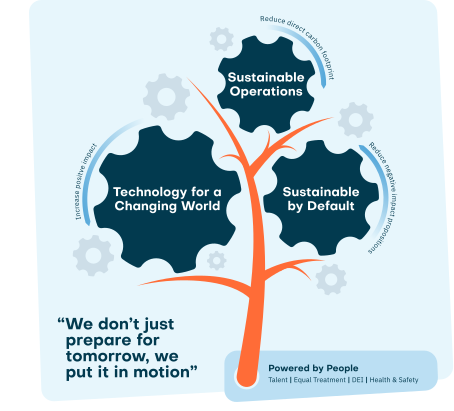
In 2025, we introduced our Nedap sustainability story: Tomorrow in Motion. This story articulates our view of sustainability as inherent to creating Technology for Life. It also articulates how, as part of our company culture and way of working, we support customers in becoming more sustainable. Tomorrow in Motion encompasses three principles: Technology for a changing world, Sustainable by default, and Sustainable operations.
Technology for a changing world
Our strategic focus is on delivering lasting value by developing Technology for a changing world. We combine our technological expertise and deep knowledge of our customers and markets to create highly relevant solutions. These solutions deliver value today and address future needs – from doing more with less to lowering GHG emissions and reducing waste.
Sustainable by default
We are committed to designing better products with the lowest possible environmental impact. This commitment is reflected in the principle of Sustainable by default. We look for improvements across every step of the product journey. We assess the impact of material choices, identify opportunities to reduce energy consumption, and prioritize responsible recycling and disposal at end of life. Our focus is on creating long-lasting, energy-efficient products that are easier to maintain, repair, and recycle. We also design solutions that grow with our clients through software-enabled expansions and upgrades, ensuring continued relevance over time.
Targets and ambition
Reduce our scope 3 GHG emissions from purchased goods and services and the use of sold products by 51.6% per euro of added value by 2030 from a 2020 base year.
Increase the circularity of our products through sustainable product design and collaboration across the value chain.
Sustainable operations
We are on our way to net-zero for our own operations: our scope 1 and 2 GHG emissions from the use of our offices and production facilities and other activities under our direct control. While our direct impact represents only a small share of our total GHG emissions, reducing it to a minimum is nonetheless a key priority. We achieve this by electrifying our operations, generating and procuring renewable energy, and improving the energy efficiency of our buildings.
Targets
Reduce our absolute scope 1 and 2 GHG emissions by 95% by 2030 from a 2020 base year.
Phase out the use of natural gas in our operations by 2030.
Phase out fossil-fuel-powered company vehicles by 2030.
Stakeholders and materiality
In 2025, we revisited our double materiality assessment (DMA) using updated knowledge and insights and reassessed the existing topics through the established scoring methodology. The outcomes were validated and further refined based on the results of a customer and supplier survey. This reassessment confirmed that ESRS E5-2 Resource outflows is no longer considered a material sustainability matter. Please refer to the table in subsection 8.3.2 Material impacts, risks and opportunities of section 8.3 Material sustainability matters for the outcomes of this process.
We will regularly review and reassess our material sustainability matters. As part of this process, we will also reevaluate the stakeholder landscape, ensuring that we capture diverse perspectives and focus on the issues most relevant to Nedap and our long-term value creation ambitions. We will use various engagement methods, such as surveys, interviews, and focus groups, to maintain an ongoing dialogue with our stakeholders. In doing so, we aim to create a feedback loop that fosters transparency and open communication, helping us advance our sustainability impact.

|
Stakeholder |
Interest |
Influence |
Impact |
Strategies for engagement |
ESG topics discussed |
|---|---|---|---|---|---|
|
Employees |
High |
Medium |
A two-way dialogue on ESG helps align employee values with sustainability goals while providing valuable feedback. It boosts engagement and encourages active participation, benefiting both employees and Nedap’s ESG efforts. |
Regular updates, involvement in decision-making processes, training and development programs. |
Personal development, well-being & DEI, strategic updates, circularity of products, sustainability goals. |
|
Customers |
High |
Medium |
An open dialogue on ESG with customers helps Nedap align with their values, meet transparency expectations and stay competitive by addressing demands for sustainable practices while gaining valuable customer insights. |
Customer feedback surveys, product demonstrations, business partner events, newsletters. |
Product improvement, sustainability goals, customer satisfaction. |
|
Investors and shareholders |
Medium |
High |
Engaging investors and shareholders on ESG strengthens alignment with Nedap’s sustainability goals and reinforces confidence in the company’s long-term strategy. |
Annual reports, shareholder meetings, financial performance updates, individual meetings. |
Financial performance, strategic plans (e.g., Step Up!), DEI, progress on sustainability policy. |
|
Suppliers |
Medium |
Medium |
A two-way dialogue on ESG with suppliers ensures alignment with Nedap’s sustainability standards while offering suppliers the opportunity to improve their practices and meet market demands for responsible sourcing. This collaboration fosters stronger partnerships and promotes mutual growth by building a more sustainable and resilient supply chain. |
Regular communication, partnership agreements, performance reviews, supplier surveys. |
Regulatory compliance (e.g., CSRD, GDPR), sector-specific regulations, ESG ambitions and goals. |
|
End-users and consumers |
Medium |
Low |
A dialogue with end-users and consumers ensures alignment with sustainability goals, enhances trust and gives consumers a voice in shaping responsible product use. This engagement encourages more sustainable behavior, benefiting both Nedap and its end-users and consumers. |
Support services, newsletters. |
Ways to raise concerns, end-of-life instructions. |
|
Government and regulators |
Low |
High |
Regulatory compliance. |
Compliance reports, participation in regulatory consultations. |
Compliance. |
|
Media |
Low |
Medium |
Public perception and brand reputation. |
Press releases, media briefings, proactive communication strategies. |
Progress on ESG topics. |
|
Competitors |
Low |
Medium |
Market competition. |
Market analysis, competitive intelligence, strategic positioning. |